

Rhythm Innovations’ definition, operating method, and why the world needs a new category
Frontline roles have familiar labels: driver, technician, operator, courier, installer, mechanic. Those labels describe what people do. They rarely describe what drives loss: compounded exposure that follows a worker across the full shift across locations, handoffs, changing conditions, and supervision gaps.
Rhythm Innovations is introducing a missing operating category one designed to be educational for the market and buildable for enterprise operations – the dual risk worker.
A Dual Risk Worker is a mobile worker who executes work outside the vehicle and faces two risk environments in the same day:
- Mobility exposure travel to and between places of work
- Work execution exposure hands on activity outside the vehicle in real operating environments
Either exposure can independently produce severe outcomes: injury, property loss, public harm, regulatory consequences, and reputational damage.
Modern operations do not fail only at the worksite, and they do not fail only on the road. They fail in the seams: handoffs, time pressure, route compression, changing conditions, fatigue drift, interruption load, and supervision blind spots. Dual Risk is the lived reality of delivery work, field service work, and permit controlled high hazard work. Most organizations still govern it like two separate worlds.
Rhythm’s position is direct: Dual Risk must be governed as one operating system with one enterprise standard for control, one exception driven decision loop, and proof grade closure that eliminates open exposure.
Why does the Dual-Risk Worker definition exist now
Work is more mobile, more distributed, and more time compressed than it was even five years ago:
- Route density is higher
- Customer windows are tighter
- Crews are leaner
- Supervisor span of control is wider
- Conditions change faster than manual oversight can keep up
At the same time, the “job” itself has expanded:
- A delivery route can include lifting, carry distances, stairs, customer site variability, and installation at delivery not just driving.
- A service call can include ladder work, energized systems, confined areas, and chemicals not just “tech work.”
- A high hazard job can require permit control, isolation, and verification not just “PPE compliance.”
So, we need language that accurately names the exposure. “Driver” doesn’t. “Field tech” doesn’t. “Installer” doesn’t. Dual Risk Worker does.
This is not a marketing term. It is a buildable definition designed to change how readiness, supervision, learning, escalation, and closure are run across real operations, not just policy binders.
The Dual Risk Worker definition
A Dual Risk Worker is defined by three facts:
1) Mobility is part of the job
Travel is not incidental. It is operational output time, distance, routing, urgency, and conditions all shape exposure. “The shift” is not only what happens at the destination. The shift includes the movement between destinations.
2) Work is executed outside the vehicle
The second risk is not “getting out of the cab.” It is performing tasks in real environments: customer sites, plant floors, rooftops, roadsides, basements, mechanical rooms, utility corridors, and delivery/installation zones. This is where hands on hazards live: force, height, energy, motion, environment, and human interaction.
3) Conditions change faster than manual governance
Weather, traffic, job complexity, permit conditions, equipment status, fatigue, interruptions, and repeat exposure patterns shift across the day. The worker’s exposure can drift out of standard long before a manual process detects it.
A Dual Risk Worker is not “a driver who sometimes does labor.” A Dual Risk Worker is a frontline operator whose day requires governed control across mobility + work execution where each exception is turned into one decision, with one owner, one due time, and proof grade closure.
The Three Dual Risk Worker Archetypes (where the risk lives)
To make Dual Risk governable at scale, Rhythm defines three archetypes. These are not job titles. They are risk environments that determine the right credentialing, training bundle, and readiness gates.
We use NAICS and SIC alignment to standardize credential and learning bundles across industries and roles. In practice, this means: Archetype → NAICS/SIC mapping → credential & training bundle → readiness requirements → governed gates → proof grade closure
Archetype A: Delivery Dual Risk Worker
This is the worker whose route is the job, and the job continues once they arrive.
Examples: courier/express delivery; food and beverage route delivery; last mile parcel; white glove; installation at delivery.
What makes the risk dual:
- Mobility exposure: route density, backing events, urban exposure, distraction, fatigue drift, schedule compression, intersection complexity.
- Work execution exposure: lifting/ergonomics, slips/trips/falls, stairs/carries, customer premises hazards, property damage, tool use, installation errors, interaction risk.
The point: it is the same worker, in the same shift, moving from road → doorstep → installation zone → road again. Exposure is continuous so control must be continuous.
Archetype B: Field Service Dual Risk Worker
This is the worker who travels to restore, maintain, or repair systems under time pressure in varied conditions.
Examples: HVAC/mechanical services; pest control; electrical service; elevator/building maintenance; telecom; facility maintenance.
What makes the risk dual:
- Mobility exposure: multi stop multi-stop routing, on-call response, variable conditions, distractions, weather, fatigue, urgency driving.
- Work execution exposure: ladders, confined areas, energized components, chemicals, rotating machinery, troubleshooting under constraints, customer site variability.
The point: the “jobsite” is not one place. It is a chain of places. Control must move with the worker and remain inside standard across the day.
Archetype C: High Hazard Dual Risk Worker
This is the worker whose tasks require formal control disciplines because consequence potential is severe.
Examples: confined space; hot work; working at heights; energized electrical; permit controlled operations.
What makes the risk dual:
- Mobility exposure still exists, often under schedule pressure and timing commitments.
- Work execution exposure is permit grade: entry conditions, isolation/LOTO, atmospheric hazards, rescue readiness, arc flash boundaries, fall protection anchoring, supervision requirements, procedural verification.
The point: high hazard cannot run on “best effort.” It requires decision integrity: controlled gates, accountable ownership, due time, and verified closure with evidence.
The Operating Standard: The Work Moments
Rhythm governs Dual Risk using the same Work Moments that run Fit to Drive and Fit to Work. The standard must be unified across the day because the worker’s exposure is unified across the day.
- Start Control: Before work is released, the question is: Are we operating in control right now? Start Control produces a dispatch safe decision state, not a vague status.
- Containment: When a signal indicates drift, contain exposure before it spreads – stop, limit, correct, reassess, reassign, and escalate. Containment is how minor drift doesn’t become major loss.
- Closeout: Work is not “done” when it is reported. Work is done when the condition is returned to standard and the loop is closed no open exposure, no hidden exceptions.
- Supervisor Command View: Supervisors govern span of control through exceptions only: what is out of standard, who owns it, and when it must be closed.
- Repeat Exposure Prevention: Single events are not the real threat. Repeat patterns are. Dual Risk governance must detect recurrence early, escalate appropriately, and prevent the next severe outcome.
- Proof Packet: is the closure requirement across all moments: evidence attached, action taken, outcome confirmed and reset achieved.
The Three Gates (how control is enforced)
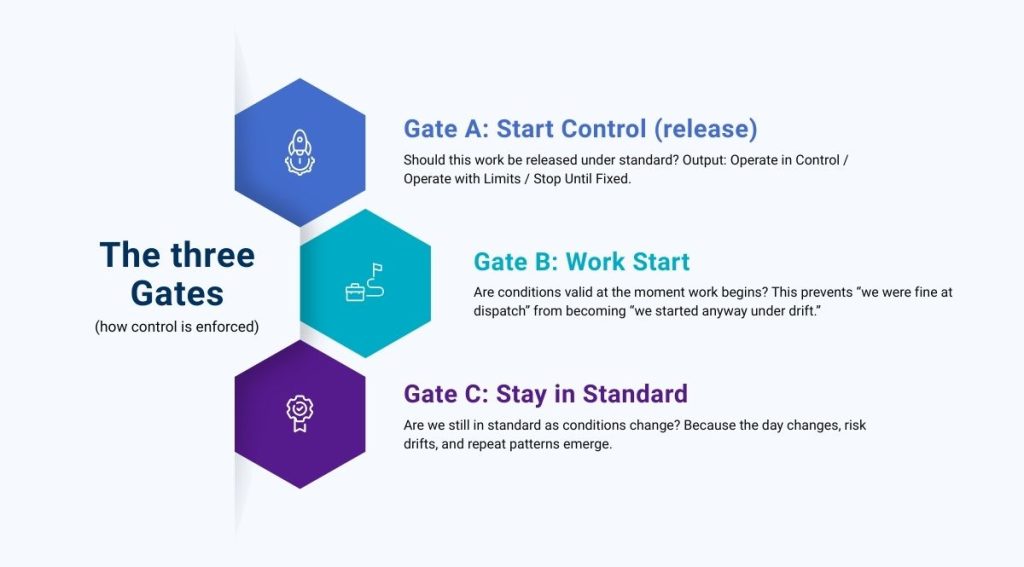
Dual Risk becomes real through three readiness gates:
Gate A: Start Control (release)
Should this work be released under standard? Output: Operate in Control / Operate with Limits / Stop Until Fixed.
Gate B: Work Start
Are conditions valid at the moment work begins? This prevents “we were fine at dispatch” from becoming “we started anyway under drift.”
Gate C: Stay in Standard
Are we still in standard as conditions change? Because the day changes, risk drifts, and repeat patterns emerge.
Populations (who is regulated and why it matters)
Dual Risk exists in regulated and non-regulated fleets. Rhythm uses Populations to standardize readiness depth:
- POP 1: 26,001+ lbs
- POP 2: 10,001 to 26,000 lbs
- POP 3: Nonregulated fleets
Population does not determine whether risk exists. It influences minimum evidence and control disciplines. The key point is that Dual Risk governance must work across all three populations because loss does not restrict itself to regulated categories.
What Rhythm Innovations provides for Dual Risk Workers
Rhythm provides enterprise line of sight through a Command Center that is built for governance, not reporting. The goal is decision grade clarity, exception only control, and proof grade closure.
In practice, the Command Center delivers:
- Ready now counts (cleared / conditional / no go) across region, population, job type, and supervisor span of control
- Topic exception types so action are specific: mobility exposure, fatigue drift, credential gaps, permit control requirements, work at height controls, energized work controls, equipment readiness gaps
- Repeat pattern detection and escalation because repeated drift is the precursor to severe loss
- Supervisor Command View (exceptions only): open loops, missing owner/due/proof, overdue queues, and recurrence escalation
- Worker command status and closure requirements: what closes, who owns closure, due time expectations, and proof standards
- Governed overrides with override history: what was overridden, by whom, why, and what evidence supported it
This is how a large organization manages Dual Risk without drowning supervisors in noise. Leadership governs what is out of standard. Everything else stays quiet.
How closure works (proof grade standard)
Dual Risk governance fails when exceptions become commentary. Rhythm closes loops structurally:
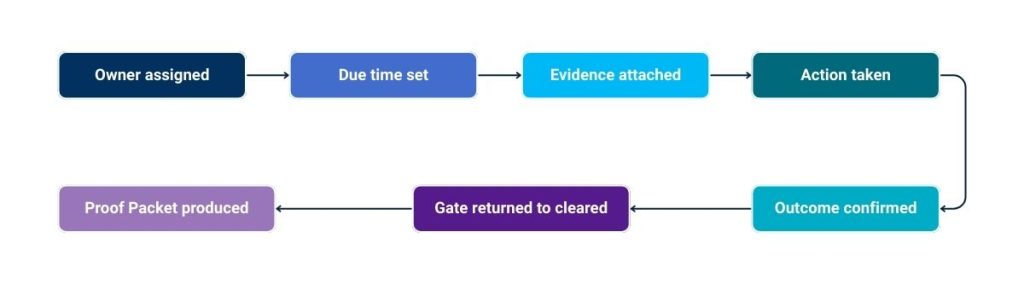
- Owner assigned
- Due time set
- Evidence attached
- Action taken
- Outcome confirmed
- Gate returned to cleared
- Proof Packet produced
That sequence matters. It turns operational intent into governed execution and prevents “open exposure” from living invisibly inside the day.
Why the Dual-Risk Worker category
Dual Risk is not about labeling people. It is about naming reality so it can be governed. The same worker can be safe at one moment and drift out of standard in the next because the operating system changes around them. If you want fewer surprises, fewer severe events, and more defensible operations, you do not need more activity.
You need to make decision integrity:
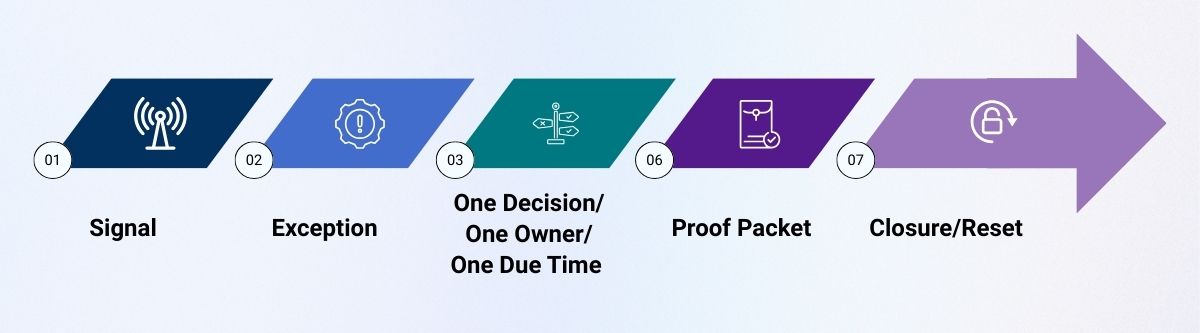
- Signal
- Exception
- One Decision
- One Owner
- One Due Time
- Proof Packet
- Closure/Reset
That is Rhythm Innovations’ definition of the Dual Risk Worker. And it is the operating standard we have adopted.
“Dual Risk is the reality of modern frontline work: movement plus execution, in changing conditions, under time pressure. If you can’t govern both exposures as one system with owners, due times, and proof you aren’t managing risk. You’re hoping.”