


Fleet safety fails without execution. Learn how SaferFleet™ turns telematics, MVR, and compliance alerts into clear actions that reduce driver risk.
Introduction
According to the Federal Motor Carrier Safety Administration (FMCSA), large truck crashes continue to create major operational and human consequences across the transportation industry every year. At the same time, roadside inspection data consistently shows recurring violations tied to hours-of-service compliance, vehicle maintenance, and unsafe driving behavior. Meanwhile, the National Safety Council estimates the average cost of a medically consulted workplace injury exceeds $40,000 before accounting for litigation, downtime, cargo disruption, equipment loss, operational delays, or reputational damage.
The transportation industry does not have a visibility problem.
It has an execution problem.
Over the last decade, fleets have invested heavily in telematics, AI-enabled cameras, GPS tracking, ELD systems, MVR monitoring, and compliance platforms. Fleets today can see more operational activity than ever before. Speeding alerts, distracted driving events, harsh braking, failed inspections, maintenance defects, and driver compliance concerns are now surfaced almost instantly.
But visibility alone does not reduce risk.
An alert is not action. A dashboard is not operational control. Data is not accountability.
The Fleet Safety Gap Nobody Talks About
Most fleets already know where their risks are.
They can see:
- Speeding alerts
- Distracted driving events
- Hours-of-service violations
- Failed roadside inspections
- Open maintenance defects
- Unsafe driving behaviors
- Driver qualification issues
The challenge is not identifying the problem. The challenge is what happens next.
What Is the “Execution Gap”?
Execution gap: The space between knowing a risk exists and proving that the right action was taken, by the right owner, before the risk creates harm.
That gap is where operational exposure grows.
Why Visibility Alone Does Not Create Safer Fleets
Technology has transformed transportation operations.
Telematics and AI video systems have created measurable improvements across the industry. Multiple fleet technology studies show that structured driver coaching programs can reduce risky driving behaviors by 20-40%, while fleets implementing video-based safety initiatives often report preventable crash reductions between 15-30%.
But many fleets eventually experience something frustrating: performance improvement slows down because technology created visibility without creating operational discipline.
The Most Dangerous Moment in Fleet Operations
The highest-risk moment in fleet operations is often not the incident itself. It is the moment after the incident. Because that moment determines whether the organization converts visibility into action.
A Real-World Example of the Execution Gap
A driver receives multiple speeding alerts during the week. At the same time, the vehicle has an unresolved maintenance defect identified during a pre-trip inspection. The telematics system captured the driving behavior. The maintenance platform documented the defect, but no one connected the signals together.
No dispatch decision changed. No coaching occurred. No operational review happened. The truck continued moving.
From Monitoring Risk to Managing Risk
SaferFleet™ was not designed to become another dashboard full of alerts. It was designed to help fleets operationalize action. Inside the Rhythm Command Center posture, operational events follow a governed flow:
Signal → Decision → Owner → Due Date → Action → Proof → Closure
The Maintenance Problem Fleets Continue to Underestimate
FMCSA roadside inspection data consistently shows vehicle maintenance violations remain among the most common contributors to fleet exposure.
The problem is usually not a lack of awareness. The problem is breakdown in operational follow-through.
Why Accountability Changes Outcomes
Research from McKinsey & Company on operational transformation consistently shows organizations improve performance when accountability becomes explicit, measurable, and operationally embedded.
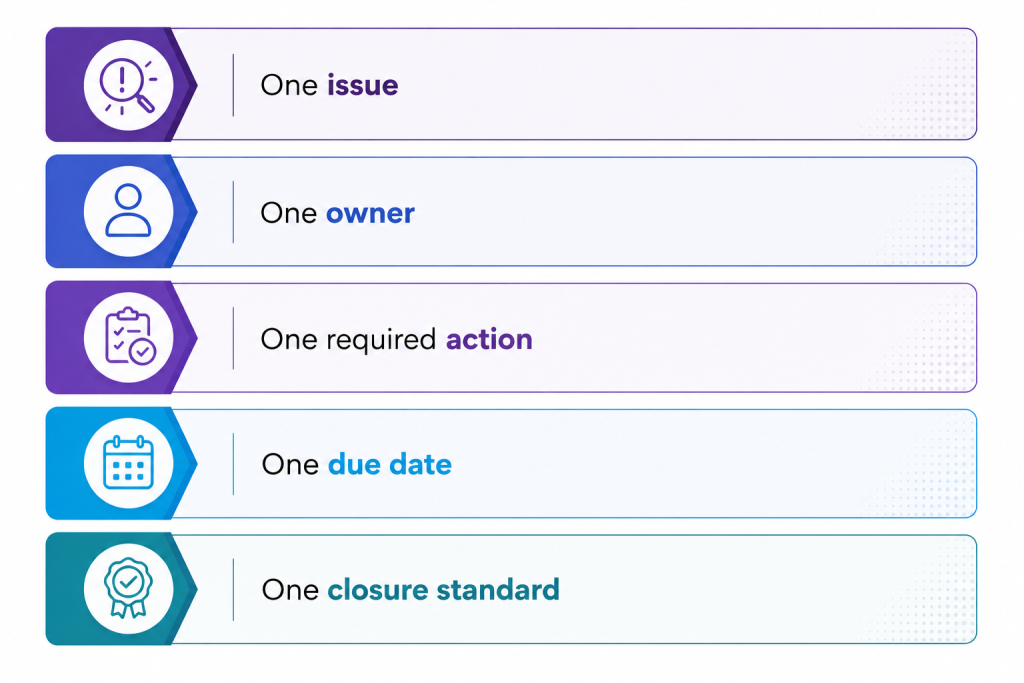
- One issue
- One owner
- One required action
- One due date
- One closure standard
What Good Looks Like
Strong fleet operations are not built on alerts alone. They are built on disciplined execution.
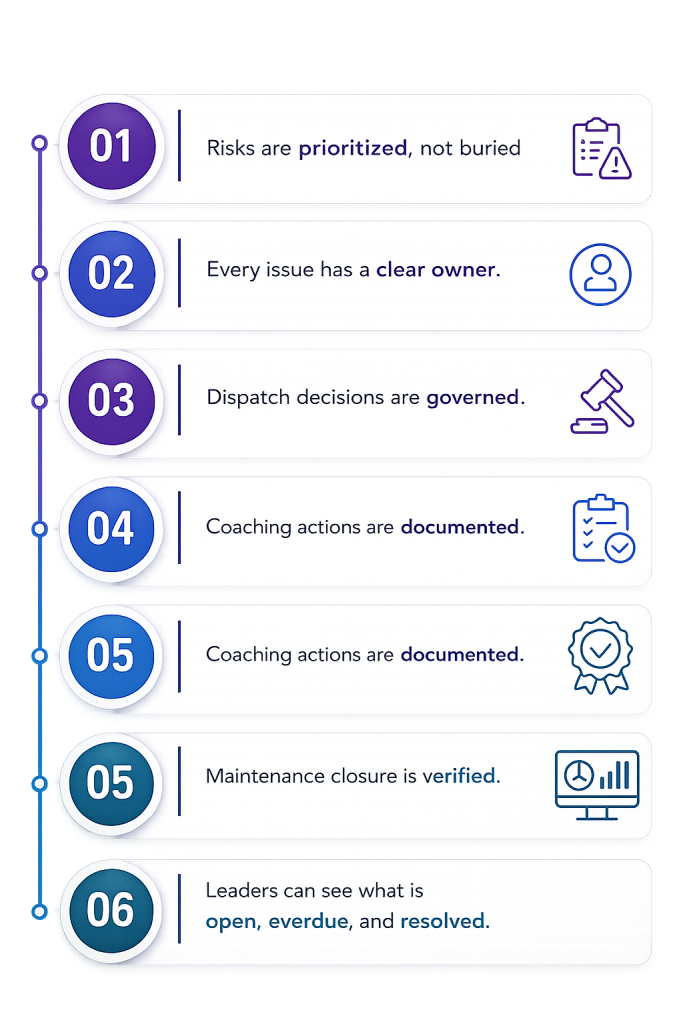
What good looks like:
- Risks are prioritized, not buried.
- Every issue has a clear owner.
- Dispatch decisions are governed.
- Coaching actions are documented.
- Maintenance closure is verified.
- Leaders can see what is open, overdue, and resolved.
Why This Matters for Fleet Leaders
Fleet leaders are not asking for more alerts. They are asking for fewer surprises. They want safer drivers, road-ready vehicles, cleaner inspections, stronger accountability, and confidence that the operation is actually under control.
The Future of Fleet Safety Is Operational Readiness
The next evolution of fleet safety will center around operational readiness. The fleets that outperform over the next decade will not necessarily be the fleets with the most technology. They will be the fleets with the strongest operational discipline around that technology.
The Bottom Line
Fleet safety programs fail when organizations confuse visibility with control.
Telematics matter.
AI cameras matter.
ELDs matter.
Compliance systems matter.
But none of those technologies reduce risk by themselves. Execution does.
SaferFleet™ helps fleets move from: “We saw it” to “We owned it, acted on it, proved it, and closed it.”
Fleet Safety Self-Assessment
- When a high-risk alert occurs, do we have a clearly defined operational response or are we relying on individuals to figure it out in real time?
- Can we prove that corrective actions were completed, verified, and closed or can we only prove the alert existed?
- Do our dispatch decisions actively consider driver readiness, maintenance readiness, and open operational risk?
- Are unsafe patterns decreasing over time because of disciplined execution or are the same issues repeatedly resurfacing?
- If leadership reviewed our operation today, could we confidently demonstrate ownership, accountability, action, proof, and closure across our highest-risk exposures?
References & Sources
- FMCSA Large Truck and Bus Crash Facts https://www.fmcsa.dot.gov/safety/data-and-statistics/large-truck-and-bus-crash-facts
- FMCSA Safety Measurement System (SMS) https://csa.fmcsa.dot.gov
- National Safety Council Injury Facts https://injuryfacts.nsc.org
- American Transportation Research Institute (ATRI) https://truckingresearch.org
- Rhythm Innovations https://www.rhythminnovations.com
- McKinsey & Company – Operational Transformation Research https://www.mckinsey.com/capabilities/operations/our-insights