


By Nathaniel Miller , VP, Center of Excellence, Rhythm Innovations
For decades, fleet safety programs were built around a familiar question: was this driver qualified? The license was valid, the medical certificate was on file, the MVR was reviewed, and the driver qualification file was complete. Those controls still matter. But they answer a historical question. The more urgent question is operational: does this driver meet our readiness standard for dispatch today?
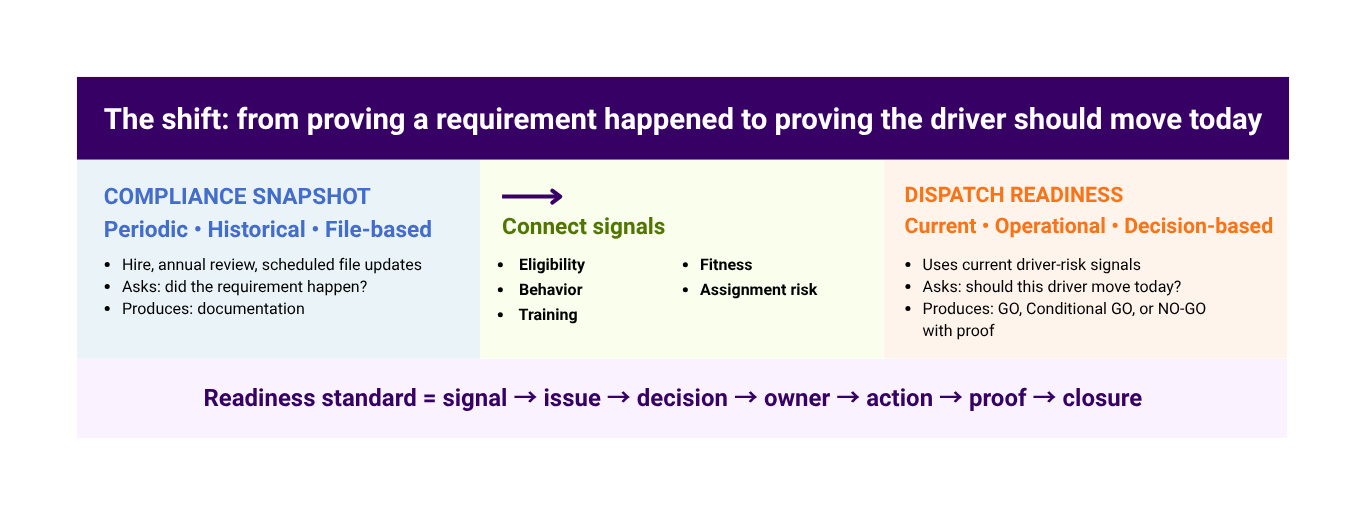
Driver readiness is the current verification that a driver is legally eligible, medically qualified, appropriately trained, behaviorally within standard, and fit for the assigned work at the moment of dispatch. Compliance confirms that required steps occurred. Readiness confirms that current information was used to make a clear GO, Conditional GO, or NO-GO decision before the vehicle moves.
Why Compliance Alone Is No Longer Enough
Risk does not operate on an annual cycle. A driver can receive a serious violation, lose license eligibility, allow a medical certificate to lapse, accumulate high-risk telematics events, or become unavailable under hours-of-service limits weeks before the next scheduled review. Under a snapshot model, the organization may discover the exposure only after a crash, inspection, claim, or lawsuit.
The stakes explain the shift. FMCSA reported that fatal crashes involving large trucks and buses rose 26.4% from 2016 through 2022. NHTSA reported 528,177 large trucks involved in police-reported crashes in 2023. FMCSA’s 2025 crash-cost methodology prices a non-injury large-truck crash at $49,398, an injury crash at $326,810, and a fatal crash at $15.2 million in 2023 dollars. The U.S. Chamber Institute for Legal Reform also found a $21 million median nuclear verdict across more than 1,200 verdicts from 2013 through 2022, with auto accident cases among the highest median verdict categories.
The Gap Is Between the Systems
Most fleets do not lack data. They have MVRs, telematics, camera events, driver qualification files, medical certificates, training records, hours-of-service data, claims history, and coaching records. The failure point is that those signals often live in separate systems, move through different departments, and reach decision-makers at different times.
That is where exposure develops. A telematics platform may show repeated speeding, but the supervisor assigning work may not see it. HR may know a credential is expiring, but dispatch may keep assigning the driver. Safety may assign coaching, but no one verifies completion or confirms behavior changed. Driver readiness closes that gap by connecting the signal to an accountable operating decision.
What Driver Readiness Should Measure
Driver readiness is not a single score. It is a combined view of four risk dimensions: licensing and legal eligibility; driving behavior; experience and training currency; and fitness for duty. Licensing includes MVR monitoring, CDL and endorsement validation, medical certificate status, Clearinghouse status where applicable, and disqualifying restrictions. Behavior includes speeding, harsh braking, distraction, following distance, fatigue indicators, repeated high-risk events, and whether the pattern improves after intervention.
Experience is often underweighted. FMCSA/U.S. DOT research found that drivers with fewer than five years of experience were 41% more likely to be assigned the critical reason in a serious large-truck crash than more experienced drivers. For fleets that constantly hire, onboard, and replace drivers, experience and training currency are not HR details; they are readiness signals. Fitness for duty adds medical qualification, hours-of-service availability, work-rest patterns, fatigue signals, and readiness for the assigned task.
A Signal Is Not a Control
Seeing risk is not the same as controlling it. A dashboard may show an expired credential. A telematics system may generate repeated speeding alerts. A safety manager may send a coaching assignment. None of that proves the exposure was resolved. A mature readiness program creates a closed governance loop: signal → issue → decision → owner → action → proof → closure.
Every meaningful signal should answer: what happened, how serious is it, does it affect dispatch, who owns the response, what action is required, when is it due, what proof confirms completion, and has the risk actually been reduced? This is the difference between alert generation and governed action.
The Dispatch Decision: GO, Conditional GO, NO-GO
Driver readiness should not leave dispatchers with an unstructured alert list. It should support a defined decision. GO means the driver meets the readiness standard and may be dispatched. Conditional GO means the driver may proceed only after a defined condition is addressed or with specific controls in place, such as supervisor approval, a lower-risk route, targeted coaching, temporary restrictions, or increased monitoring. NO-GO means the driver does not meet the standard and should not be dispatched until the disqualifying condition is resolved.
What Leading Fleets Are Doing Differently
Leading fleets verify readiness before dispatch, not only at hire. They monitor continuously instead of periodically, shrinking the time between a change in risk and the organization’s response. They connect behavior data to intervention, then test whether the intervention worked. They also look for patterns in the pond: repeated speeding may be an individual issue, but it may also reveal unrealistic routing, scheduling pressure, weak supervision, or incentives that reward production over readiness.
They also treat readiness as an insurability asset. Insurers want more than written policies; they want evidence that the policy operates. A fleet that can demonstrate continuous monitoring, defined dispatch criteria, assigned ownership, proof of action, and measurable improvement has a stronger risk-control story than a fleet relying on compliance documentation alone.
How SaferFleet™ Supports the Readiness Model
Rhythm Innovations developed SaferFleet™ to bring driver-risk information into a unified readiness and governance view. Depending on available data sources and integrations, that view may include MVR and licensing information, medical qualification status, telematics behavior signals, training and coaching activity, driver and vehicle exceptions, assigned actions, ownership, due dates, proof of completion, readiness decisions, and operating status.
The objective is not to replace every fleet, telematics, HR, or compliance system. The objective is to connect critical signals, prioritize the issues that matter, support consistent decisions, and create a visible path from risk identification to verified closure. Compliance is still essential. But compliance is the floor. Readiness is the operating standard.
Frequently Asked Questions
What is driver readiness?
Driver readiness is the current confirmation that a driver meets legal, medical, training, behavioral, and operational requirements for dispatch.
How is readiness different from DOT compliance?
Compliance confirms required records and processes are in place. Readiness uses current information to decide whether a driver should be released into the operation now.
Does readiness guarantee a crash will not happen?
No system can guarantee that. Readiness helps the organization make a more informed, consistent, documented decision before dispatch.
References
- FMCSA, Crash Causal Factors Program – https://www.fmcsa.dot.gov/CCFP
- NHTSA, Traffic Safety Facts: Large Trucks, 2023 Data – https://crashstats.nhtsa.dot.gov/Api/Public/ViewPublication/813717.pdf
- FMCSA, Crash Cost Methodology 2025 – https://www.fmcsa.dot.gov/safety/data-and-statistics/federal-motor-carrier-safety-administration-crash-cost-methodology-2025
- U.S. Chamber Institute for Legal Reform, Nuclear Verdicts: An Update on Trends, Causes, and Solutions (May 2024) – https://instituteforlegalreform.com/wp-content/uploads/2024/05/ILR-May-2024-Nuclear-Verdicts-Study.pdf
- FMCSA/U.S. DOT, Analysis of Driver Critical Reason and Years of Driving Experience in Large Truck Crashes – https://rosap.ntl.bts.gov/view/dot/31693