


Five Lessons Nearly 200 Fleet Customers Taught Us About Running a Business, Managing Risk, and Insurability
Fleet businesses are being judged differently than they were even a few years ago. It is no longer enough to show historical loss runs, annual mileage, driver counts, and a few safety programs at renewal. Insurers, brokers, MGAs, agents, and fleet leaders increasingly need to understand whether a business can prove control over risk before the next claim, the next renewal, or the next operating disruption.
More than two hundred fleet businesses have now shaped the SaferFleet™ journey. The most important lesson is not the number of miles monitored or the volume of data collected. It is what repeated exposure to real operations reveals about risk, insurance, and the decisions that connect them. For fleet operators, the issue is continuity: keeping vehicles moving, employees working, customers served, and businesses insurable. For the insurance ecosystem, the issue is credibility: knowing which organizations simply have risk and which ones are actively controlling it.
For insurance executives and fleet leaders, five findings stand out:
- Visibility must produce action. More data does not reduce risk unless it changes a decision.
- Insurability is built every day. Renewal reveals the accumulated evidence; it does not create it.
- Response matters as much as the signal. A company that sees a problem, acts, and improves is a different risk from one that ignores it.
- Intervention connects operations to underwriting. What was seen, who acted, and what changed may matter as much as what happened historically.
- Continuous underwriting requires proof. Prediction is useful; documented action and measurable improvement make it credible.
1. Visibility Must Produce Action
Fleet risk-related data now arrive from MVRs, telematics, ELDs, roadside inspections, maintenance systems, claims, brokers, carriers, and federal safety data. That creates visibility, but visibility is not the outcome. A red icon does not coach a driver. An alert does not repair a vehicle. A score does not close a corrective action.
The next generation of fleet risk is a closed loop: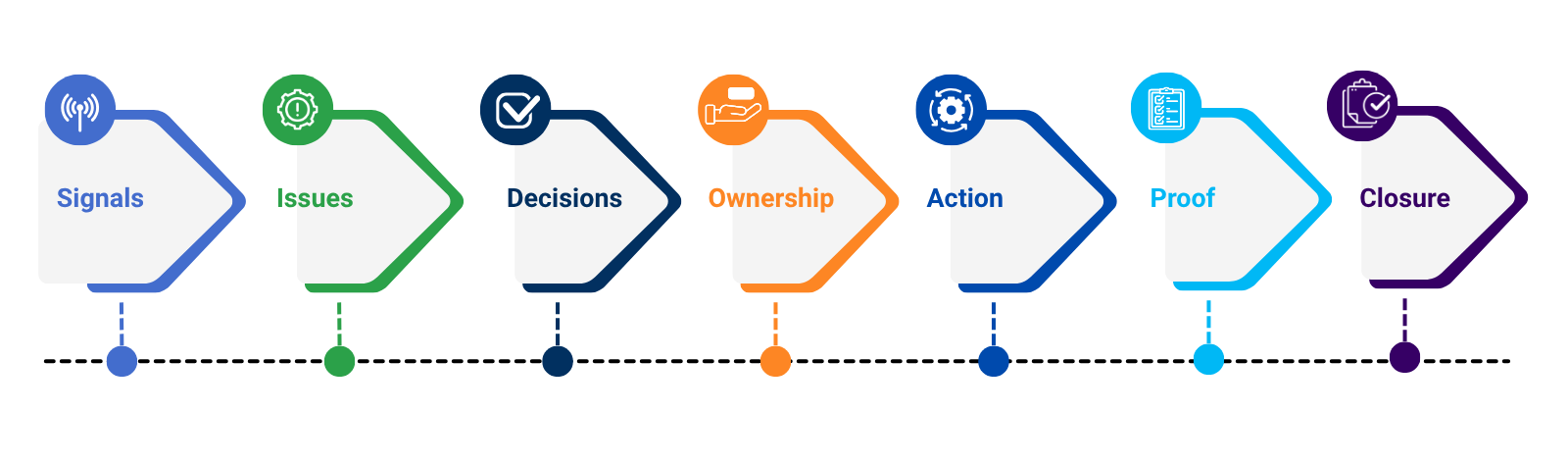
|
That is the shift from reporting infrastructure to operating infrastructure: from telling leaders where risk exists to helping them control what happens because of it. Visibility is valuable only when it creates a timely decision, assigns the right owner, and leaves behind evidence that the organization responded.
2. Insurability Is Built Every Day, Not at Renewal
For a fleet, insurance is more than a financing decision; it is permission to keep moving. Premium pressure, adverse loss experience, or non renewal can quickly become an operating problem.
Insurability is therefore accumulated through daily choices: who is allowed to drive, whether a vehicle is ready, whether repeat speeding is addressed, whether maintenance defects are closed, and whether corrective action can be proven. Renewal is often simply the moment when months of operating behavior become visible to the insurance system.
This is why insurability should be treated as an operating discipline, not an annual event. A fleet may not control every exposure it faces, but it can control how quickly it identifies issues, how consistently it acts, and how well it proves improvement. That evidence matters when markets harden, claim severity rises, or an underwriter needs more than a narrative to support a decision.
3. The Response to Risk May Matter More Than the Signal
Two companies can show the same adverse signal and still represent different risks. One ignores it. The other identifies it, assigns responsibility, intervenes, documents the action, and improves.
That is a central idea behind continuous underwriting. The better question is not only, “Does this fleet have risk?” Every fleet does. It is, “How does this fleet respond when risk appears?”
4. Intervention Connects Visibility to Loss Prevention
One of the clearest lessons from the SaferFleet journey is the importance of intervention. A recent SaferFleet view showed 383 intervention records within one company’s activity set. Each record marked a moment when risk moved from being visible to being actionable: someone could be informed, ownership could be assigned, and a corrective step could begin before the issue developed further.
We should be precise about that number. An intervention is not automatically a prevented collision, prevented claim, saved life, or avoided nuclear verdict. Those outcomes require evidence. What it does represent is a documented opportunity to interrupt a risk pathway before loss.
That distinction is important. Claims avoided, severe injuries avoided, fatalities avoided, and nuclear verdicts avoided are outcomes that require rigorous evidence. Intervention records are different, but still powerful. They create a measurable trail between exposure and response. They show whether the organization saw the issue, acted on the issue, and created the conditions for improvement.
For carriers, MGAs, brokers, and agents, this can become a more meaningful conversation than loss history alone. Loss history tells what happened. Intervention history begins to show how the company behaves when risk appears. For fleet leaders, it creates a practical management rhythm: identify the signal, prioritize the issue, coach the person, repair the asset, close the action, and prove the result.
5. Continuous Underwriting Requires Proof, Not Prediction Alone
Early SaferFleet portfolio analysis has produced encouraging directional signals. In one matched analysis, claims frequency moved from approximately 13.02 claims per million miles to 8.31, a directional reduction of approximately 36.2 percent over the measurement period.
That is encouraging, but it does not establish causation. Matched populations can change, mileage coverage can vary, claims can develop, and other operating changes may occur at the same time. For an insurance executive or fleet leader, two defensible proof points are more valuable than ten attractive statistics that cannot survive scrutiny.
The standard should be clear: connect baseline risk, intervention, action, and outcome, and distinguish what is proven, what is directional, and what has not yet been demonstrated. Prediction identifies where risk may be developing. Operational control determines what happens next. Proof shows whether the response changed the risk.
What Nearly 200 Fleet Businesses Have Really Taught Us
Nearly two hundred businesses matter because they represent nearly 200 operating environments, leadership teams, insurance relationships, and sets of real world decisions. Across them, the same pattern keeps appearing: risk is not managed by information alone. It is managed by people making better decisions with information at the right time.
Technology does not replace leadership, coaching, maintenance discipline, driver accountability, or judgment. Its role is to make risk easier to see, priorities easier to understand, actions easier to execute, and improvement easier to demonstrate.
The larger opportunity is not simply to help insurers identify which risks to accept or reject. It is to help fleet operators, agents, brokers, MGAs, carriers, safety professionals, and underwriters create better risks over time. That is a different ambition. It moves the conversation from selection to improvement, from scorekeeping to operating discipline, and from annual review to continuous evidence.
The Next Chapter: Continuous Underwriting for Commercial Fleets
The first generation of fleet technology collected data. The second visualized it. The next must help organizations control what happens because of it. When a meaningful signal appears, someone should know, someone should own the response, action should be completed, evidence should be captured, and improvement should be visible.
That is the promise of continuous underwriting: a more current view not only of where risk exists, but of what the fleet is doing about it before the next claim, annual review, or renewal decision. In that model, underwriting does not become less disciplined; it becomes better informed. Safety does not become more abstract; it becomes more accountable. And fleet leadership gains a clearer way to show that risk is being managed while the business continues to operate.
Keeping the Wheels Moving
This work is not about keeping dashboards updated. It is about helping people make better decisions before risk makes the decision for them. Keeping the wheels moving is not just a phrase. It is the operating outcome that matters: drivers safer, fleets productive, businesses insurable, employees working, customers served, and communities moving.