

In this Blog:
1. What Exactly Is a Driver Qualification File?
2. The Industry Pain Points: Where DQ File Management Goes Wrong
3. What the Enforcement Numbers Actually Show
4. FMCSA Annual Roadside Violation Data
5. The Real Cost: FMCSA Fines and Civil Penalty Exposure
6. How Rhythm SaferFleet™ Solves the DQ File Problem
7. Before the Truck Moves: The Only Question That Matters
What Exactly Is a Driver Qualification File?
A Driver Qualification (DQ) file is a mandatory compliance record that every motor carrier must maintain for each of its commercial drivers. Under 49 CFR Part 391, the federal regulation governing driver qualification requirements, carriers must collect, verify, and keep on file a defined set of documents that prove a driver is legally and medically fit to operate a commercial motor vehicle (CMV).1
Think of it as a driver’s complete compliance profile & not just a copy of their license, but the full picture: their employment application, drug screening history, driving record, medical fitness certification, consent forms, and more. Regulators, insurance companies, and courts all look at this file when something goes wrong. So do FMCSA investigators during compliance reviews.
The Industry Pain Points: Where DQ File Management Goes Wrong
Managing DQ files sounds straightforward on paper. In practice, it’s one of the most consistently broken processes in fleet operations, especially as fleets scale past a handful of drivers. The core problem isn’t that fleet managers don’t understand the requirements. It’s that the tools they’re using weren’t built for the job.
No Single Source of Truth
DQ documents end up scattered across email threads, shared drives, filing cabinets, and spreadsheets. Nobody has a complete picture, and “complete” looks different depending on who you ask.
Expiries Get Missed
Medical certificates, annual MVRs, and drug test cycles renew on different schedules. Without automated tracking, renewals slip through quietly, until a roadside inspector finds them.
No Approval Audit Trail
When a document is collected via email or text, there’s no record of who reviewed it, whether it was valid, or when it was accepted. That gap becomes a liability in litigation or a compliance investigation.
Reactive, Not Proactive
Compliance gaps surface at the worst moments at a roadside stop, during an audit, or after an incident. By then, the violation has already occurred. There’s no retroactive fix.
The result is a compliance posture that looks fine from the inside and falls apart under external scrutiny. For a fleet of 20 drivers, managing this manually might be manageable. For a fleet of 100 or 200, it’s not and the enforcement data proves it.
What the Enforcement Numbers Actually Show
DQ file failures are not theoretical. They show up in roadside inspection data, in out-of-service orders, and in FMCSA enforcement statistics every year. The 2025 numbers tell a consistent story.
The Scale of Roadside Enforcement
In calendar year 2025, FMCSA recorded more than 3.1 million commercial vehicle roadside inspections nationally, along with more than 11,000 motor carrier investigations and over 532,000 traffic enforcement inspections.2 3 Compliance isn’t tested once a year during an audit, it’s tested every day, on every road, in every state.
How Often Drivers Are Pulled Out of Service
During CVSA’s 2025 International Road check, a focused three-day enforcement event where inspectors conducted more than 56,000 inspections, including nearly 55,000 driver-level checks where CDL status, medical certification, and other DQ-related credentials were directly reviewed. Of those, 3,342 drivers were placed out of service. A driver out-of-service rate of 6.1%, or roughly 1 in every 16 drivers inspected.6
No CDL accounted for 24.4% of all driver out-of-service violations (810 violations).
No medical card accounted for another 14.9% (493 violations). Together, just those two DQ file documents drove nearly 40% of all driver OOS orders during the event.6
FMCSA Annual Roadside Violation Data
The CVSA enforcement event data is reinforced by annual national roadside inspection data from FMCSA’s MCMIS database. For the medical certificate-related violation line specifically, FMCSA recorded:
- 25,970 violations nationally tied to valid medical certificate-related issues
- 5,322 out-of-service instances tied to that violation line alone
- A 2.2% share of all roadside violations represented by that single medical certificate line3
These are not edge cases. They are predictable, recurring failure points and they are directly preventable with a properly maintained DQ file.
The Real Cost: FMCSA Fines and Civil Penalty Exposure
The compliance stakes are not limited to operational disruption when a driver is placed out of service. The penalty outcomes depend on violation type, what exactly was missing, whether the carrier had prior violations, and whether the lapse was negligent or wilful. What the FMCSA civil penalty schedule under 49 CFR Part 386 Appendix B establishes is the range of exposure a carrier faces when DQ files aren’t maintained properly.5
| Violation Type | Penalty Exposure |
|---|---|
| Recordkeeping violations (missing DQ documents) | Up to $1,584/day · Max $15,846 |
| Knowing falsification of records | Up to $15,846 |
| Non-recordkeeping violations (carrier level) | Up to $19,246 per violation |
| Non-recordkeeping violations (driver level) | Up to $4,812 per violation |
| CDL-related violations | Up to $7,155 |
| Employer knowingly allowing OOS CDL holder to operate | $7,155 – $39,615 |
The highest exposure scenario is $7,155 to $39,615 which applies when a carrier had knowledge of a driver qualification issue and dispatched the driver anyway.5 That’s exactly what happens when DQ file management is reactive: an expired document isn’t flagged, dispatch proceeds, and only later does the fleet discover the driver shouldn’t have been on the road. The liability extends well beyond the fine into insurance claims, litigation exposure, and potential negligent entrustment claims.
In 2023, a major U.S. carrier reached a $306 million settlement in a wrongful death lawsuit involving a commercial truck crash. Plaintiff attorneys cited inadequate driver qualification and monitoring records. DQ files are not just a regulatory formality, they are litigation defence documents. 8
How Rhythm SaferFleet™ Solves the DQ File Problem
Rhythm’s SaferFleet™ platform was built specifically to address the gap between what FMCSA requires and what manual compliance processes actually deliver. The DQ Files module replaces fragmented, reactive document management with a structured, digital-first system that keeps every driver’s file complete, current, and audit-ready at any fleet size.
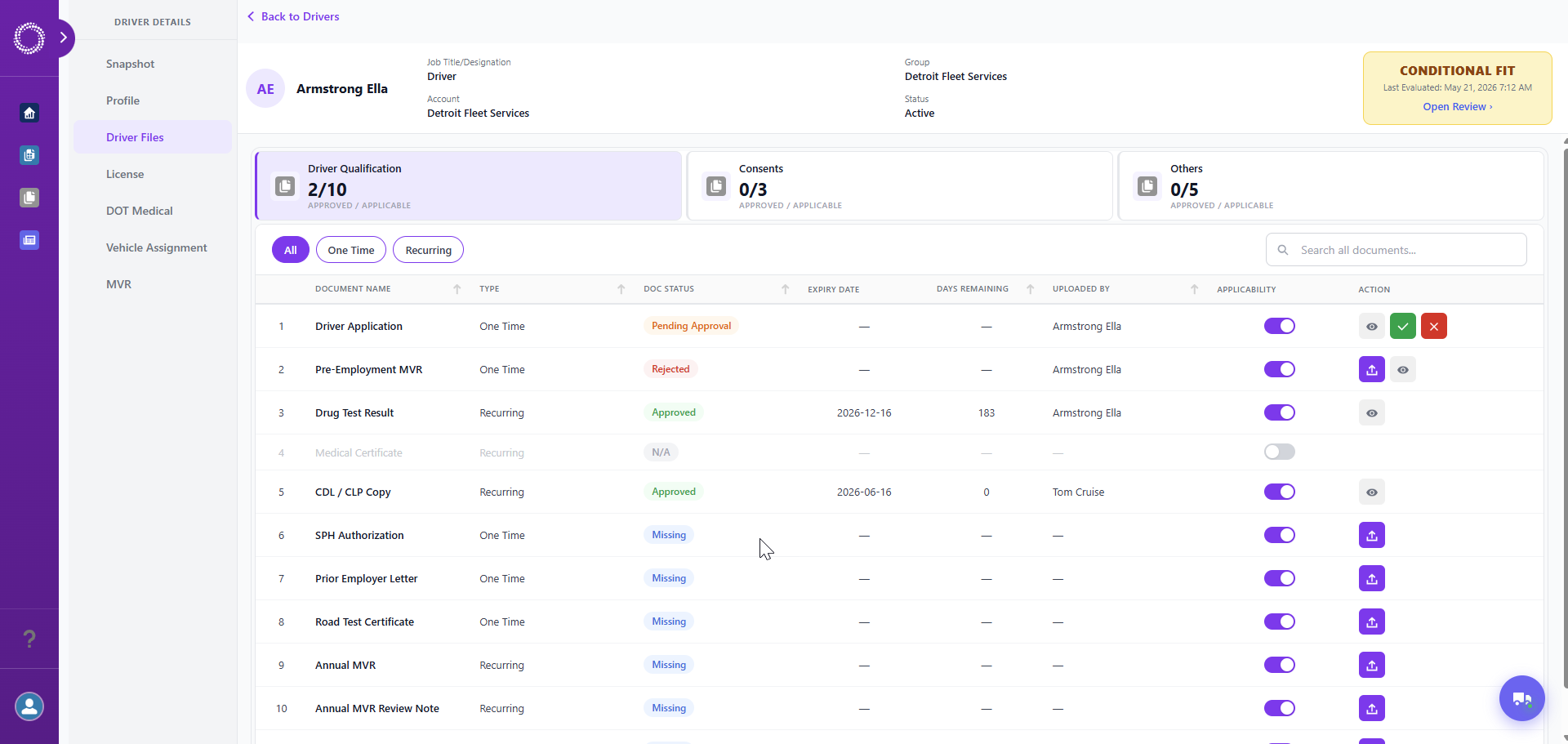
17-Doc Predefined Checklist
Every fleet starts with the same compliance baseline, one single source of truth for all driver documents, across Driver Qualifications, Consents, and Other Documents.
Structured Approval Workflow
Drivers upload documents via mobile. Fleet owners review, approve, or reject with mandatory notes. Every action is timestamped, creating a full, defensible audit trail.
Automatic Expiry Tracking
Recurring documents carry expiry dates with live days-remaining counters. Automated alerts fire before a document lapses & not after the roadside inspector finds it.
DQ Completion Badge
Color-coded at driver and fleet level giving fleet owners an instant at-a-glance view of compliance status across their entire roster.
Driver Wallet
Every driver gets a live mobile view of their own qualification status, upcoming expirations, and required actions so they’re never blindsided at a weigh station.
5 Real-Time Document Statuses
Missing · Pending · Approved · Rejected · Expired. Fleet owners see exactly where every document stands, for every driver, in real time. No spreadsheet. No guesswork.
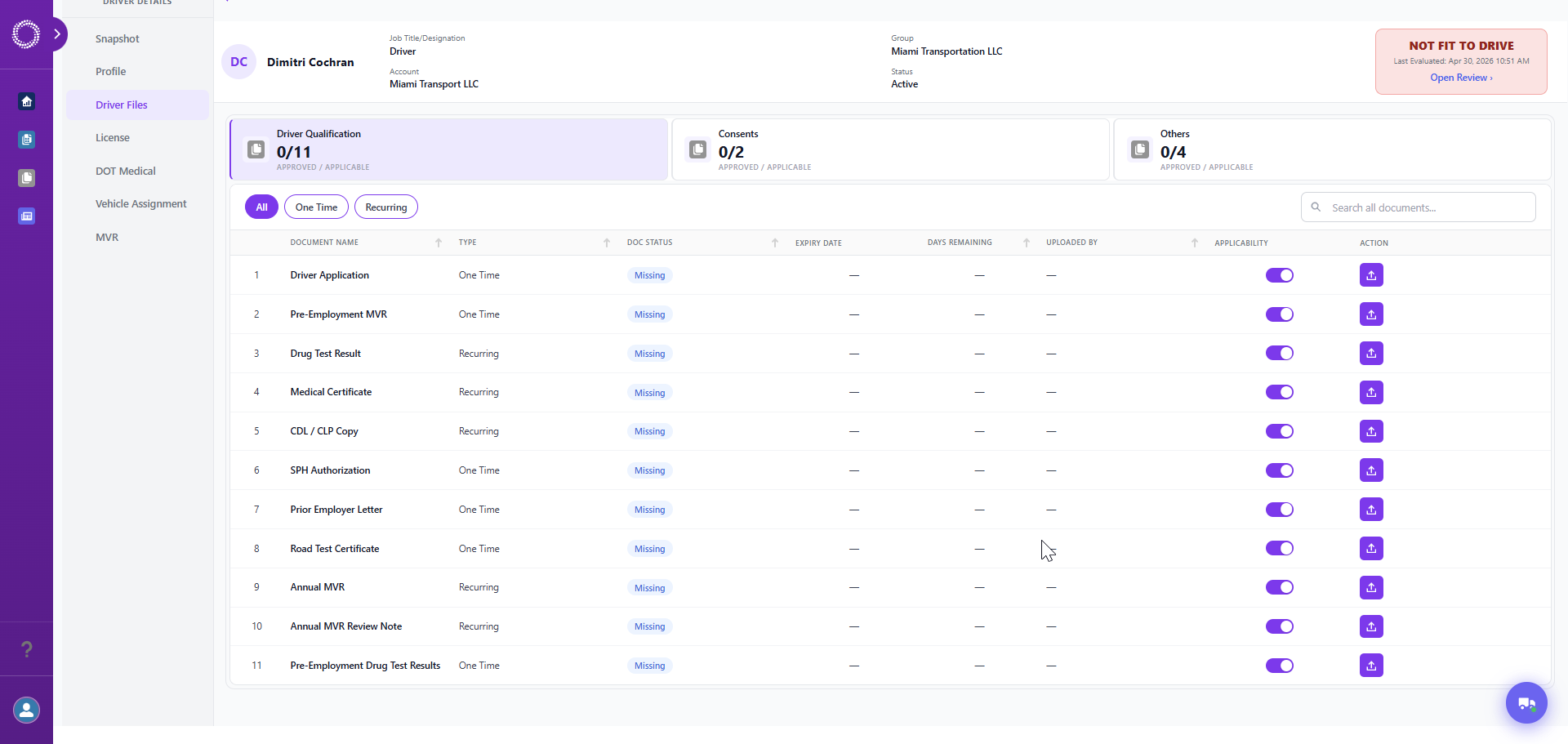
Rhythm turns DQ file management from a reactive paper chase into a proactive compliance control. Before Rhythm, gaps surfaced during audits and incidents. With Rhythm, they’re caught and closed before the truck moves.
Before the Truck Moves: The Only Question That Matters
Driver Qualification files exist to answer one question before every trip: Is this driver legally and medically qualified to operate this vehicle, right now?
The enforcement data from 2025 shows what happens when that question goes unanswered. Nearly one in four driver out-of-service violations at roadside inspections involved no CDL.6 Nearly one in six involved no medical card.6 More than 25,000 medical certificate-related violations were recorded nationally in a single year.3 And the civil penalty schedule can turn a single missing document into five-figure financial exposure or six-figure exposure if the lapse is accompanied by a serious incident.5
The good news is that DQ file compliance is entirely preventable as a failure mode. The documents are known. The renewal schedules are defined. The regulatory requirements haven’t changed. What’s changed is the availability of tools that make managing them at scale across 10 drivers or 1,000 genuinely practical.
Want to learn how our Driver Qualification File Checklist tool works? Book a demo or Contact us.
References
- 49 CFR Part 391 – Qualifications of Drivers (eCFR) – https://www.ecfr.gov/current/title-49/subtitle-B/chapter-III/subchapter-B/part-391
- FMCSA Analysis & Information Online / MCMIS: CY 2025 Annual Enforcement Totals (Updated May 5, 2026) – https://ai.fmcsa.dot.gov/
- FMCSA Analysis & Information Online: Roadside Inspections, All Violations (MCMIS Snapshot March 27, 2026) – https://ai.fmcsa.dot.gov/EnforcementPrograms/Inspections
- FMCSA Analysis & Information Online: Safety Investigations, All Violations (CY 2025) – https://ai.fmcsa.dot.gov/EnforcementPrograms/Investigations?type=AllViolations
- 49 CFR Part 386 Appendix B: FMCSA Civil Penalty Schedule (eCFR) – https://www.ecfr.gov/current/title-49/subtitle-B/chapter-III/subchapter-B/part-386/appendix-Appendix%20B%20to%20Part%20386
- CVSA – 2025 International Roadcheck Results – https://cvsa.org/news/2025-roadcheck-results/
- FMCSA – Driver Fitness BASIC: Safety Measurement System – https://www.fmcsa.dot.gov/safety/carrier-safety/driver-fitness-basic
- Transport Topics / Industry Legal Reporting – Nuclear Verdicts and Trucking Litigation Trends (2023–2025) – https://www.ttnews.com
- FMCSA – Drug & Alcohol Clearinghouse: Employer Obligations – https://clearinghouse.fmcsa.dot.gov/Resource/ViewDocument/192
- FMCSA – Medical Programs: Commercial Driver Medical Certification Requirements – https://www.fmcsa.dot.gov/medical