


Session 2 of the SaferFleet™ Master Class Series addressed one question: how do fleets turn regulatory box-checking into a real defense against risk?
In this blog we discuss:
- The compliance signals FMCSA is currently watching and how to track them yourself
- Where carriers have gaps during investigations
- Why the cost of getting it wrong is increasing fast
- The three pillars that move safety from a cost center to a competitive advantage
- A practical first step any fleet can take this immediately
Compliance is the floor, not the ceiling
FMCSA’s Safety Measurement System is already analyzing your roadside inspections, violations, and crash reports from the last two years to decide who gets an intervention and it’s not a “black box”. Every carrier can see the same data FMCSA does through their own portal credentials. Most don’t. And with violations remaining on your record for 24 months, monitoring your own profile isn’t optional.
The gaps that surface most often during investigations aren’t exotic:
Missing MVRs. Because a CDL holder’s medical certification now ties electronically to their motor vehicle record, a missing MVR often means you can’t prove the driver is medically qualified.
Stale annual reviews. Carriers who pull an MVR once and don’t look again for 12 months are the ones blindsided by CDL downgrades.
Records of duty status. Consistent hours-of-service oversight remains one of the most frequent findings.
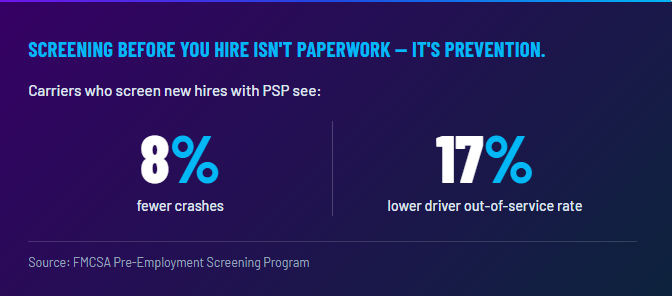
The strongest move is a proactive one most carriers skip: FMCSA’s Pre-Employment Screening Program, which surfaces three years of inspection history and five years of crash data before you hire.
The cost of getting it wrong is climbing
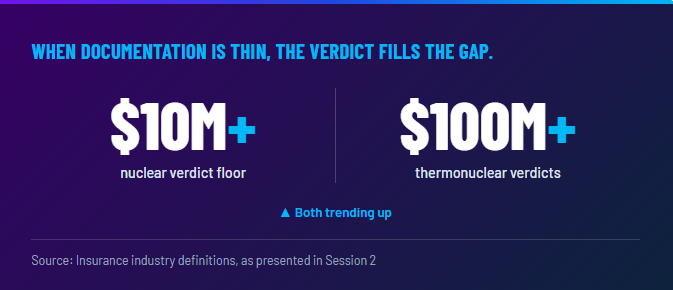
Before you can innovate, you have to nail the basic “blocking and tackling” because the penalty for weak fundamentals is no longer just a conditional rating. It’s litigation.
The rise of nuclear verdicts and thermonuclear verdicts is fueled by social inflation: shifting jury attitudes, broader court definitions of liability, and climbing awards for pain, suffering, and emotional distress. In that climate, your driver qualification files, Pre-employment screens, and documented diligence stop being compliance artifacts, they become your duty-of-care defense.
From cost center to competitive advantage: three pillars
The obstacle facing most fleets isn’t a lack of data, mature operations are drowning in it. The obstacle is fragmented data and inconsistent execution. Moving from compliance to innovation rests on three pillars:
Unify the data. Telematics, AI-facing cameras, inspections, maintenance, and training records, pulled into one connected ecosystem with shared definitions so “risk” means the same thing across every site.
Predict with AI. Lagging indicators aren’t going away; the goal is having the right leading indicators that actually move them. Monitoring programs have been shown to cut harsh-driving events, rapid acceleration, hard braking, collisions within the first six months.
Empower action. Intelligence has to be role-specific like what a driver acts on today isn’t what an executive needs on a dashboard, tied together in a closed loop: detect, interpret, assign, act, verify.
Empower the worker, engage the supervisor
Change starts with the person behind the wheel. A driver’s score, DVIR history, inspection timeliness, and expiring credentials usually live in separate systems, so no one sees the whole picture until something breaks. Put it in one place and the driver can self-correct, guided by a principle worth repeating: be as quick to applaud as you are to coach.
That fragmentation is the core problem. Many organizations run 8 to 14 separate systems in this space, an orchestra trying to play from a dozen different sheets of music. It rarely stays harmonious past the second note.
The real takeaway is a mindset shift: compliance is the floor, not the ceiling. Rules tell you what happened. Intelligence tells you what’s about to.
Want the full breakdown, the complete compliance walkthrough, and the three-pillar model?