




In this Blog:
- What the data says: Seasonal patterns are structural, not random
- Weather is not a niche risk driver: Rain and wet pavement dominate the picture
- What FMCSA requires: “Extreme Caution” is an operating standard, not a suggestion
- The governance moves: Pre-Stage controls before the season arrives
- The promise of Rhythm: Turning seasonal risk from awareness into governed decisions
- Prepared vs. unprepared: The Decision Integrity matrix
What the Data says: Seasonal Patterns are Structural, not Random
Monthly exposure and outcome patterns vary across the calendar year, and the variation is meaningful, not noise. NHTSA’s analysis of crash fatalities by month documents significant differences across months and days, reinforcing that risk is not flat across the year.[1]
Operational takeaway: the question is not “which month is worst.” It is that governance cannot be flat if risk is not flat. Prepared fleets keep performance decisions anchored to rate discipline and trend integrity, not seasonal volatility.
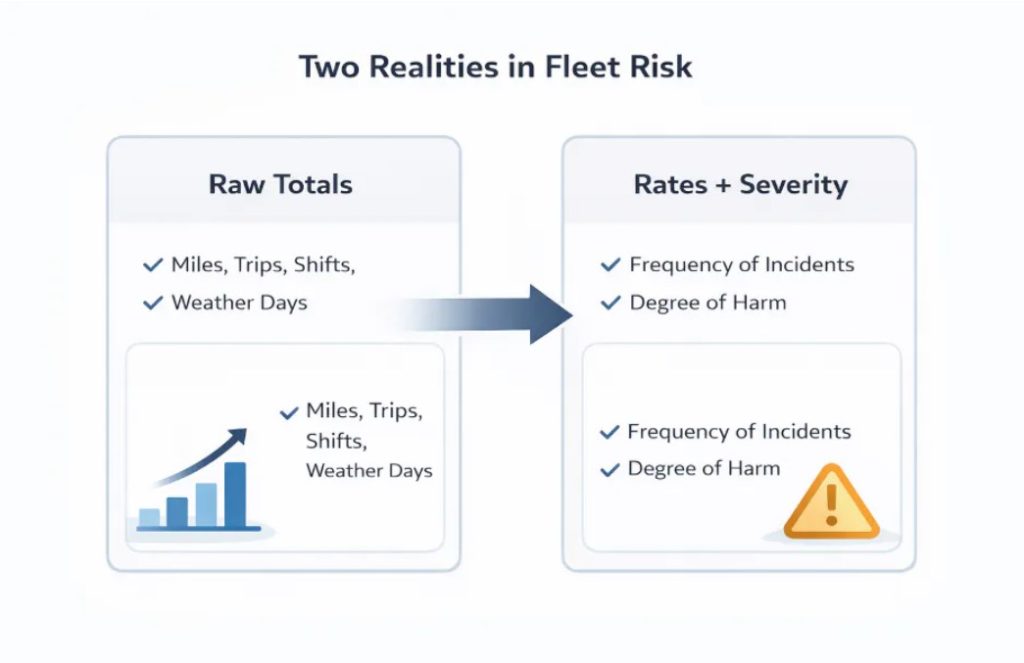
When fleets look only at raw totals, they blur two different realities:
- Outcome rate / severity (how often and how bad things go wrong per unit of exposure)
- Exposure volume (miles, trips, shifts, weather days)
Weather is not a Niche-Risk, Driver Rain and Wet Pavement Dominate the Picture
Many safety programs over index on snow and ice. FHWA’s road weather statistics highlight a more uncomfortable reality: weather related crash risk is frequently a rain/wet pavement problem.[3][4]
FHWA reports that 75% of weather-related vehicle crashes occur on wet pavement and 47% happen during rainfall.[3] FHWA also notes that most weather-related crashes happen during rain or mist conditions.[4]
Operational implication: If “seasonal readiness” in your fleet starts and ends with winter messaging, you are under controlling the most common adverse condition that drives real outcomes.
What FMCSA requires: “Extreme Caution” is an Operating Standard, not a Suggestion
The regulatory baseline is explicit.
Under 49 CFR §392.14, when hazardous conditions adversely affect visibility or traction, CMV operation requires extreme caution; speed must be reduced; and if conditions become sufficiently dangerous, operation must be discontinued until the CMV can be safely operated.[5]
FMCSA guidance clarifies decision authority: under this section, the driver is clearly responsible for safe operation of the vehicle and the decision to cease operation because of hazardous conditions.[6]
FMCSA’s CSA Safety Planner reinforces the same expectation in practical terms: reduce speed under hazardous weather conditions, and discontinue operations when conditions become sufficiently dangerous.[7]
Leadership implication: it is not enough to “encourage caution.” Your organization must make it operationally possible through policy guardrails, dispatch posture, supervisor reinforcement, and evidence.
The Governance Moves: Pre-Stage Controls before the Season Arrives
Prepared fleets treat seasonality like a known risk signal and implement three non-negotiables:
1) Condition aware guardrails, (not seasonal reminders)
Define thresholds for rain, fog, snow/ice and wind advisories tied to:
- Speed discipline
- Spacing expectations
- Routing constraints
- Stop work integrity aligned to §392.14.[5]
2) Seasonal readiness reviews as decision integrity checks
- Do drivers and supervisors understand what changes by condition (not by month)?
- Does dispatch reinforce driver discretion without coercive pressure?
- Is equipment readiness tuned to seasonal defect signatures?
3) Evidence chain discipline
After any high severity event, leadership should be able to show cleanly and fast:
Conditions → control → decision → action → closure/evidence
That is where Rhythm becomes tangible: closing the gap between insight and action in day-to-day operations.
The Promise of Rhythm: Turning Seasonal Risk from Awareness into Governed Decisions
Most fleets already know that seasonality matters. Where they struggle is converting that knowledge into a consistent operating standard across thousands of decisions a day, especially when conditions shift quickly.
Rhythm is not about more reporting. It delivers an enterprise line of sight and, more importantly, confidence that decisions are made, owned, and closed the right way.
- At decision time: show who is truly ready based on current conditions clearly defining GO, Conditional GO, and STOP when conditions change.
- Defensibility that protects driver judgment: guardrails, escalation paths, and proof that the organization enabled §392.14 compliance rather than pressuring through it.[5][6][7]
- Integrated views across driver + vehicle + location + actions: seasonal spikes are rarely single variable; leadership needs the full picture.
- Governed intervention load: even during seasonal spikes, actions can be prioritized, tracked, and followed through.
- Preserve the “why” in real time: insurers, regulators, and legal teams evaluate evidence not intent when coverage, liability, and accountability are assessed.
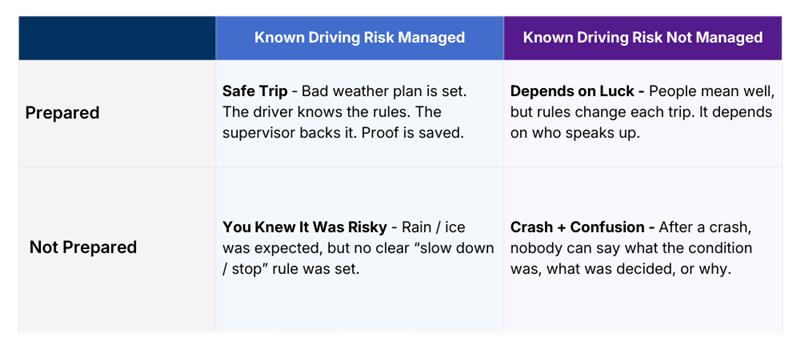
Prepared vs. Unprepared: The Decision Integrity Matrix
This is the leadership gut check: which quadrant are we willing to live in during the next severe weather week?
Close: Predictable Risk Deserves Pre-Staged Controls and Defensible Proof
Seasonality is recurring, measurable, and explicitly tied to FMCSA’s operating standard.[5] The fleets that outperform do not “talk seasonal.” They govern seasonal and they can prove decisions were consistent with §392.14 when conditions turned hazardous.
Rhythm gives logistics leaders one place to make smart, ready-to-go decisions so when risk shows up, you can clearly show you did the right thing.
Author
Nathaniel Miller, VP, Center of Excellence, Rhythm Innovations
Nathaniel “Safety Nate” Miller is Vice President, Center of Excellence, with nearly 25 years of executive leadership in Environmental Health & Safety (EHS), risk management, and business continuity. He is known for transforming safety culture, aligning systems to business objectives, and driving measurable improvements in performance and organizational resilience.
Nathaniel has held senior leadership roles at Gordon Food Service, United Technologies, Schindler Elevator Company, and SCANA Energy, leading ISO 45001/14001 adoption, Process Safety Management, and enterprise risk frameworks. A sought-after keynote speaker and author of Fix the Pond, he brings a people-first, systems-level approach that turns complexity into sustainable advantage.
Sources
- NHTSA CrashStats. Trend and Pattern Analysis of Highway Crash Fatality by Month and Day (DOT HS 809 855). https://crashstats.nhtsa.dot.gov/Api/Public/ViewPublication/809855
- NHTSA CrashStats. Summary of Motor Vehicle Traffic Crashes: 2023 Data (DOT HS 813 762, October 2025). https://crashstats.nhtsa.dot.gov/Api/Public/ViewPublication/813762
- FHWA Road Weather Management. Rain & Flooding (wet pavement/rainfall shares of weather related crashes). https://ops.fhwa.dot.gov/weather/weather_events/rain_flooding.htm
- FHWA Operations. How Do Weather Events Affect Roads? (weather related crash distribution; rain/mist share). https://ops.fhwa.dot.gov/weather/roadimpact.htm
- Electronic Code of Federal Regulations. 49 CFR §392.14 Hazardous conditions; extreme caution. https://www.ecfr.gov/current/title-49/subtitle-B/chapter-III/subchapter-B/part-392/subpart-B/section-392.14
- FMCSA Guidance Q&A. §392.14: Who makes the determination to discontinue operation? https://www.fmcsa.dot.gov/regulations/question/who-makes-determination-driver-or-carrier-conditions-are-sufficiently
- FMCSA CSA Safety Planner. Hazardous Weather Conditions (392.14). https://csa.fmcsa.dot.gov/safetyplanner/MyFiles/SubSections.aspx?ch=23&sec=68&sub=172