

By Dave Rath, Co-CEO, Rhythm Innovations, Darryl Hill, Ph.D., CSP, Jessica Jannaman, Ed.D.
In this Blog:
1. Visualizing the Revolution
2. Translating Heavy Industry to the Open Road
3. When Risk Multiplies: Precursors vs. Amplifiers
4. The Three Pillars of SIF-Driven Fleet Safety
5. Moving Beyond the Dashboard
The statistics surrounding commercial transportation are a sobering reminder of why reactive safety is no longer enough. According to the Federal Motor Carrier Safety Administration (FMCSA) and the Bureau of Labor Statistics (BLS), heavy and tractor-trailer truck drivers consistently rank among the occupations with the highest number of workplace fatalities in the United States.
American Society of Safety Professionals recently announced that that although there was a decrease in occupational fatalities based upon a BLS 2024 report, transportation industry comprised 38% of 5,070 fatalities (Professional Safety Journal, May 2026). Behind these massive numbers lies a complex web of everyday workplace realities: driver fatigue, tight delivery windows, sudden weather shifts, and mechanical blind spots.
For decades, heavy industry and manufacturing has operated under a revolutionary realization: not all safety incidents are created equal.
Inside chemical plants, refineries, and high-risk manufacturing facilities, safety managers noticed that a minor laceration rarely escalated into a catastrophe. However, a seemingly “minor” process deviation or a bypassed valve often contained the exact precursors that could lead to a life-altering explosion or fatality. This realization conceived the concept of Serious Injury and Fatality (SIF) prevention. With this new paradigm shift, industry has evolved from just counting frequency of incidents and has now begun to focus intensely on high-energy hazards.
Although this transformation has been in manufacturing for some time, the exact same paradigm shift is shaping the future of fleet operations.
Commercial fleets navigate public roadways daily, operating within exceptionally dynamic and unpredictable environments. Yet, despite millions invested in telematics, advanced dashcams, and compliance software, fleet safety programs are still stuck in a reactive loop:
- Accidents are analyzed after the wreckage is towed.
- Insurance claims are managed after legal and financial losses escalate.
- Driver coaching happens after a dangerous habit has already become normalized.
- Safety data remains trapped in isolated, disconnected spreadsheets and dashboards.
The SIF framework fundamentally transforms traditional operational paradigms and thinking. Instead of asking, “How many incidents happened this month?” forward-thinking organizations are beginning to ask:
“Which specific conditions have the highest potential for a catastrophe and how do we intervene before a driver starts the engine?”
1. Visualizing the Revolution
To fully comprehend how safety models are evolving, consider the holistic blueprint below. It illustrates the shift away from fragmented, late-stage accident analysis toward a predictive framework driven by precursors and integrated intelligence.
A Trio of Perspectives: From Factory Floors and School Buses to Enterprise Software
Rather than relying on theoretical models, our SIF mitigation framework is built on frontline experience. This approach reflects the consensus of three distinct operational viewpoints that independently arrived at the same objective.
1.1. The Plant Floor Perspective
Manufacturing moves at a high pace environment and typically involves thousands of employees interacting with heavy machinery, high-voltage equipment, and complex manufacturing lines on a daily basis. Traditional safety metrics focus on “Total Recordable Incident Rates” (TRIR) and the Heinrich Pyramid looking at first aids and medical cases. If someone cut their finger or sprained an ankle, the alarm bells rang.
But many manufacturing companies are transitioning this legacy model from looking at TRIR with focusing on those incidents which have the potential or actuality to cause a life threatening or altering incident. The truth is that a facility could go two years without a single minor injury, giving management a false sense of security, while a fatal machine-guarding bypass was waiting to happen. Manufacturing has transitioned to hunt for the weak signals, the minor machine errors, the subtle process deviations, and the unmapped high-energy hazards. Many manufacturing environments have stopped celebrating the low incident rates and start measuring SIF capacity: the active ability to fail safely without a catastrophe.
1.2. The Fleet Perspective
On the road, the “factory floor” stretches across thousands of open highway miles, subject to unpredictable weather and chaotic third-party drivers. It became clear that applying traditional, reactive safety coaching after a driver triggered a hard-braking event wasn’t enough. The need is to look at the systemic amplifiers. If a driver is consistently rushing, is it a behavioral issue, or is it an operational pressure flaw built into the routing software? The transition from simply monitoring “driver compliance” to actively building a culture where drivers can voice when a route’s risk profile moves into an unacceptable SIF threshold is paramount.
1.3. The Software Perspective
A trend in Environmental, Health & Safety (EHS) software has emerged across thousands of global corporations: the vast majority of enterprise customers are completely obsessed with TRIR. It is the gold standard metric reported to executive boards and regulators.
It is difficult to say true maturity model for SIF simply didn’t exist in the software market. System after system was architected to log minor, lagging injuries rather than capturing the interconnected indicators of low-frequency, high-severity catastrophes. It became obvious that technology was giving executive leadership teams a massive blind spot. They were checking the compliance boxes while remaining completely exposed to operational disasters. That realization is exactly what drives us today: the urgency to build systems that capture risk before it becomes a lagging statistic.
2. Translating Heavy Industry to the Open Road
How exactly do plant floor mechanics from manufacturing companies transfer to a massive transportation network like First Student? The framework translates seamlessly when you map industrial high-energy hazards to mobile, highway-speed environments and begin focusing on the controls which prevent increased risk exposure.
| Industrial SIF Prevention Concept | Translated to the Fleet SIF Model |
|---|---|
| High-Energy Hazards (e.g., Arc flash, high-pressure steam, radiation) | Kinetic Energy Hazards (e.g., an 80,000-lb tractor-trailer traveling at 65 mph) |
| Permit-to-Work / Lockout-Tagout | Automated Dispatch Lockout (e.g., Prevent assigning a driver to a route if hours-of-service are breached or a critical brake defect is flagged) |
| Process Safety Defect Tracking | Pre-Trip Inspection Failures & unaddressed mechanical wear |
| Weak Signals (e.g., Minor pipe vibration, small pressure drops) | Micro-Behaviors (e.g., 2-second glance at a phone, micro-sleep eye flutters, repetitive lane drifting) |
| Bypassing Safety Interlocks | Tampering with Telematics, ignoring in-cab alerts, or disabling ADAS systems |
3. When Risk Multiplies: Precursors vs. Amplifiers
In occupational safety, a disaster rarely happens because of a single mistake. Precursors are high-risk situation where management controls are absent, ineffective, or not complied with, and will result in a serious injury or fatality if allowed to continue (Kagerer & Simmons, 2016).
A risk amplifier is an environmental condition or other situational factor, which increases the severity or the probability that an incident will occur (Krause & Bell, 2015).
When we combine a precursor with an amplifier the potential and probability of a SIF incident to occur increases dramatically.
Let’s take a scenario of a truck driver traveling at night. The driver has inspected the vehicle, planned the route and is well rested. These management controls have helped with the precursor of driving at night. Now let’s add rain to the scenario which is an amplifier and increases the probability for an incident to occur. Individually, a driver skipping or conducting an abbreviated pre-trip inspection or facing a sudden rainstorm might seem manageable. But when these occurrences combine, the SIF potential increases exponentially.
| Fleet Accident Precursors | Risk Amplifiers |
|---|---|
|
|
The Collision Course: A tired driver (Precursor) tailgating a passenger vehicle (Amplifier) might avoid an accident on a clear afternoon. Put that same driver in a construction zone (Amplifier) at night (Amplifier) with an imbalanced load (Amplifier), and you have the perfect recipe for a multi-vehicle SIF event.
4. The Three Pillars of SIF-Driven Fleet Safety
To break the reactive cycle and systematically reduce SIF exposure, fleet operations must adopt three core pillars adapted from the world’s safest heavy industries. To break the reactive cycle and systematically eliminate SIF exposure, fleets must move past traditional “safety checklists” and adopt three unified operational pillars.
Pillar 1: Connected & Predictive Risk Intelligence
One of the primary reasons catastrophic events aren’t avoided slip through the cracks is fragmented data visibility. Critical safety signals exist across your operation, but they are typically trapped in isolated silos:
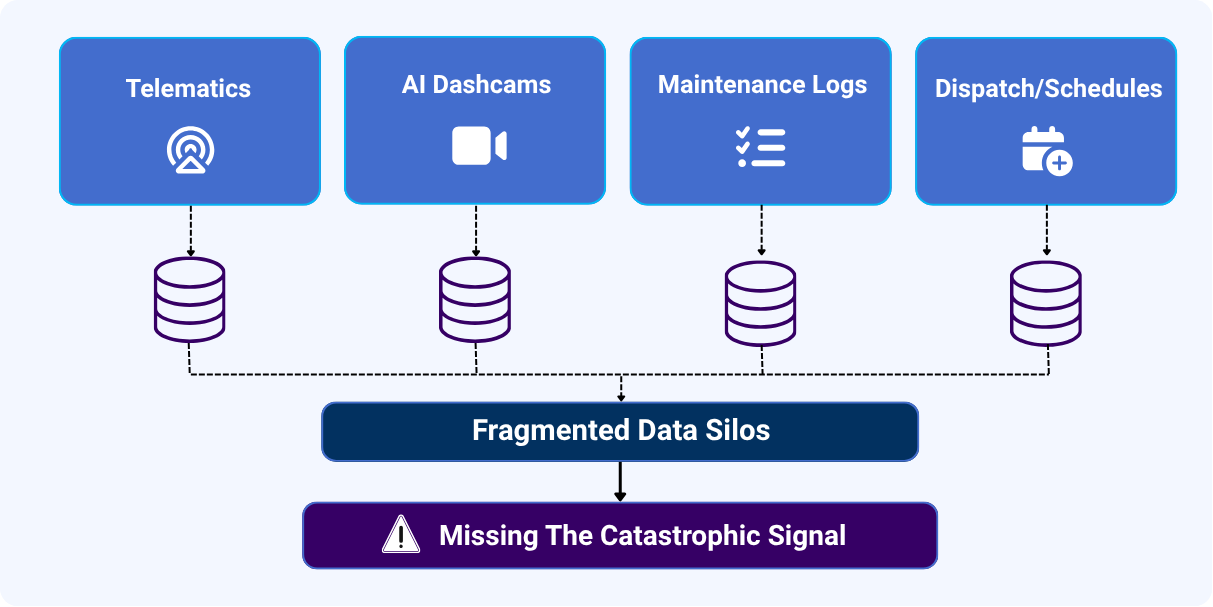
SIF prevention requires a unified risk picture. Traditional fleet safety relies heavily on lagging indicators like collision reports, historical claims, and past traffic violations. SIF prevention demands leading indicators driven by connected operational data.
Modern fleet hardware, specifically AI-powered dashcams, telematics, and electronic logging devices (ELDs) cannot just be used to review accidents after they occur. True SIF prevention occurs when these systems operate together as active, data-driven edge processors:
- AI Dashcams as Real-Time Edge Processors: Rather than waiting for a crash to review footage, computer-vision dashcams analyze micro-behaviors instantly. They detect the “weak signals” of SIF exposure, such as rolling eyelids (fatigue), downward gaze shifts (mobile phone distraction), or progressive tailgating and issue instant, in-cab alerts to break the risk chain before an impact occurs.
- Contextualizing Telematics: Telematics might flag a “hard braking” event, which sounds minor on a spreadsheet. But when paired with dashcam metadata, the system can instantly differentiate whether a driver braked hard because they were cut off, or because they were severely distracted. Data-driven models automatically categorize the true, high-severity SIF potential of the event.
- Predictive Maintenance Loops: Connecting real-time engine diagnostics and tire-pressure monitoring data directly into the dispatch feed prevents high-energy mechanical failures like a steering tire blowout at highway speeds, by grounding vehicles before a structural failure can occur.
This is where platforms like Rhythm Innovations represent a massive breakthrough. By pulling disconnected data from telematics, camera systems, maintenance platforms, and environmental feeds into a single operational brain, it transforms fragmented signals into a single, predictive risk picture. The breakthrough isn’t just having more data, it’s knowing exactly which data combination points to an imminent disaster.
Pillar 2: Governed Operational Readiness (GO / NO-GO Decisioning)
In a chemical facility or manufacturing plant, if a critical pressure valve isn’t up to spec, or if an environmental sensor triggers an alarm, the entire operation is locked down via a permit-to-work or Lockout-Tagout system.
Fleet operations need that exact same governed decision-making at the dispatch desk and throughout the workday.
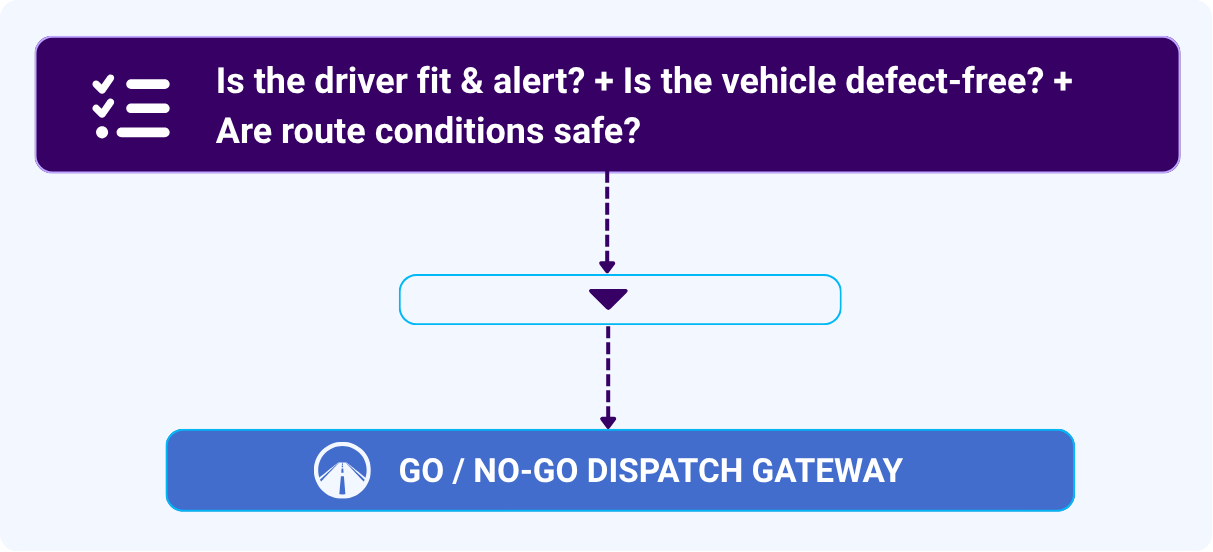
Operational readiness means using your connected risk intelligence to enforce hard, non-punitive boundaries:
- If a driver’s ELD data combined with dashcam micro-behaviors shows signs of severe, accumulating fatigue, the system flags a NO-GO.
- If a pre-trip inspection or automated diagnostic indicates a brake component is worn past compliance, the vehicle is locked out.
- If severe weather or unexpected construction zones close a route and push operational pressure past a safe threshold, the dispatch is halted or rerouted.
SIF reduction requires moving away from “hope as a strategy” and moving toward absolute, governed operational decision-making before a vehicle ever shifts into drive.
Pillar 3: High-Capacity Safety Culture & Continuous Learning
Technology and data alone will not prevent SIFs; culture is what actually changes behavior. High-exposure organizations often suffer from the “normalization of deviance” where small, daily risks (like routinely rolling through a stop sign or pushing through the final hour of a shift while exhausted to meet a deadline) become accepted as standard practice until a catastrophe occurs.
Reducing SIF exposure requires building a human-centered culture of trust where drivers feel supported rather than surveilled.
An effective SIF-based system prioritizes high-energy events and repeated exposure patterns over minor, low-risk incidents. The goal isn’t just reducing the total number of minor dents and scratches on a bumper; it’s preventing the next life-altering collision. To achieve this, fleets must build a tight, continuous feedback loop:
When an AI dashcam flags a weak signal or a driver calls in a near-miss on a dangerous route, that data shouldn’t be used as a disciplinary hammer. Instead, it must feed directly back into the operational system to train supervisors, update dispatch algorithms, and coach drivers alike. Every near-miss becomes an organizational asset designed to prevent the next escalation.
5. Moving Beyond the Dashboard
The future of fleet safety won’t be defined by who has the prettiest charts or the most dashboards. It will be defined by which organizations can connect fragmented signals faster, govern operational readiness better, and intervene sooner.
SIF thinking completely transformed industrial safety and saved thousands of lives on factory floors. By focusing on Connected Intelligence, Governed Readiness, and a Learning Culture, it’s time to bring that same life-saving discipline to the open road.